
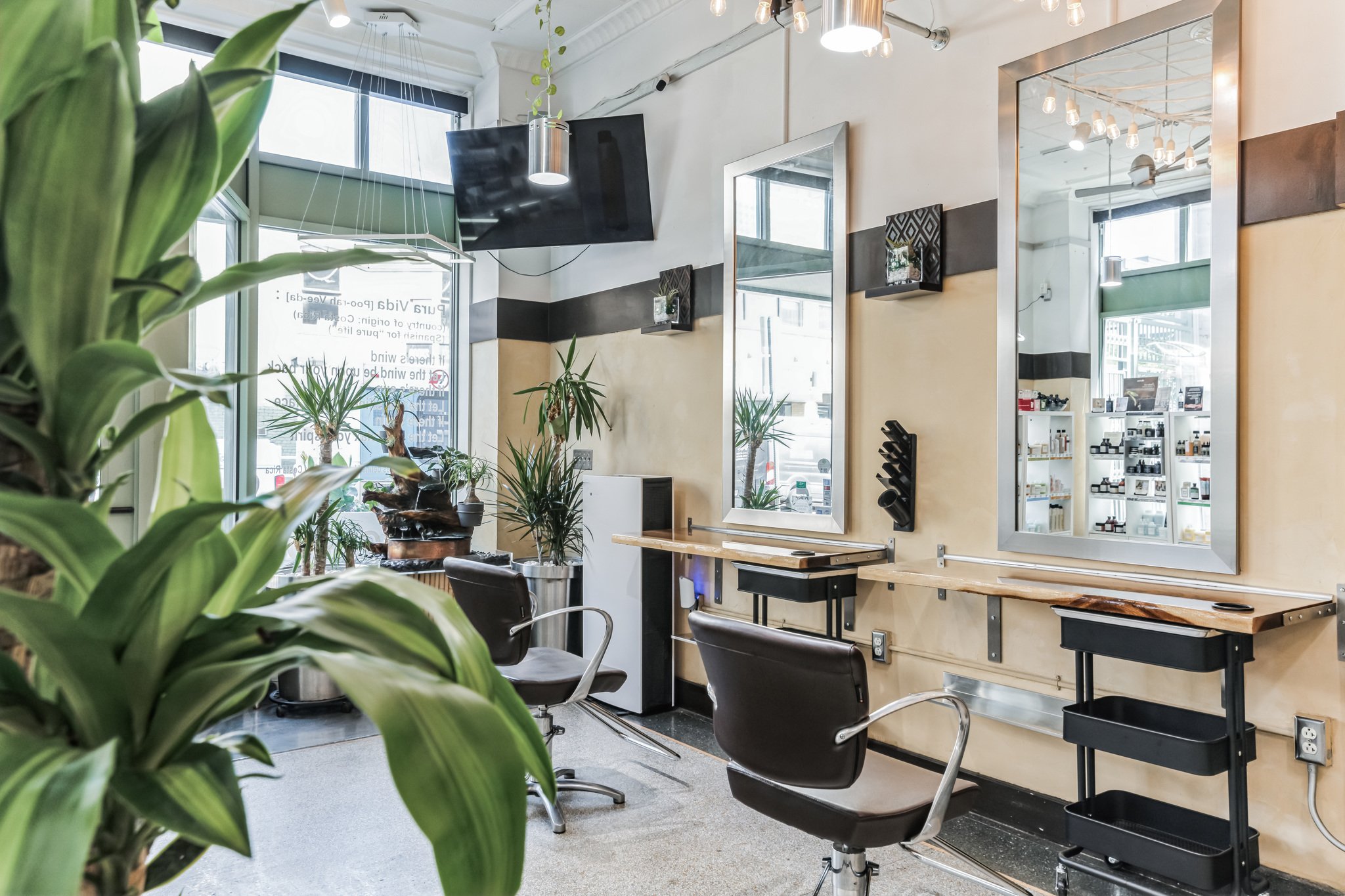
You just got home from the salon and your hair feels incredible — soft, smooth, almost weightless. Then two weeks later, you try to recreate it yourself and something's just... off. If you've ever stood in your bathroom wondering What Do Hairdressers Use to Make Your Hair Feel So Soft and Healthy? — you're not imagining the difference. It's real, and it's not just the products. It's the formulation science behind them, the techniques applied with years of muscle memory, and the professional-grade tools calibrated to your specific hair type. We work with hair like yours every day here in Ann Arbor, and what we know is this: once you understand why the salon experience feels different, you stop chasing it blindly and start making smarter decisions for your hair. This guide breaks down exactly what's happening behind the chair — so you can bring more of it home, and know when it's time to let us handle the rest.
Professional Hair Products Are Formulated Differently Than Drugstore Versions
Walk down any drugstore aisle and you'll see shelves full of shampoos and conditioners promising silky, healthy hair. But what do hairdressers use to make your hair feel so soft and healthy that you can't replicate it at home? A big part of the answer comes down to how professional products are actually made.
Most drugstore products are formulated to a price point. That's not a guess — it's how mass-market consumer goods work. Manufacturers have to hit a retail price that moves volume, so ingredient quality gets adjusted accordingly.
Professional products work from the opposite direction. Formulation comes first. The price follows.
One of the biggest differences is active ingredient concentration. A salon-grade conditioner might contain a much higher percentage of hydrolyzed proteins, amino acids, or fatty alcohols than a drugstore version with a similar name on the label. You're not just paying for a fancier bottle. You're getting more of what actually works.
There's also the issue of silicones. A lot of drugstore products use heavy silicones to create an instant slip and shine — your hair feels smooth right after washing. But over time, those silicones build up on the hair shaft and block moisture from getting in. We see this constantly. Clients come in with hair that looks shiny but feels brittle and dry underneath. The product was masking the problem, not solving it.
Professional formulas tend to use lighter, water-soluble conditioning agents that smooth the cuticle without sealing it shut. Your hair can still breathe, absorb moisture, and respond to treatments. That's a real difference you'll feel after a few weeks of consistent use.
Firsthand note: A client came in last spring after months of using a popular drugstore smoothing shampoo. Her hair looked fine in photos but felt like straw to the touch. We switched her to a sulfate-free professional cleanser with a lower pH, and within three visits the texture had completely changed.
pH balance is another place where professional products pull ahead. Healthy hair sits around a pH of 4.5 to 5.5. [Source: International Journal of Trichology, published study on hair fiber pH] Many drugstore shampoos run more alkaline, which causes the cuticle to swell and roughen. Professional shampoos are typically formulated to stay in that lower, cuticle-closing range — that's part of why your hair feels so smooth after a salon wash. The chemistry is working with your hair structure, not against it.
Here in Ann Arbor, we deal with hard water in a lot of neighborhoods. Hard water leaves mineral deposits on the hair that make it harder for any product to penetrate. Professional chelating shampoos are formulated to pull those minerals off the hair shaft before conditioning begins. Most drugstore shampoos don't include chelating agents at a meaningful level.
And look — this isn't about snobbery. It's about understanding that the ingredients list on a professional product is doing more work per drop. That's why stylists use smaller amounts. A nickel-sized amount of a professional conditioner often outperforms a palm full of a drugstore version.
Most guides will tell you to "invest in quality products" and leave it there. But the actual reason professional formulas work better is specific: higher active ingredient concentration, better pH calibration, smarter conditioning agents, and targeted solutions for real-world water and environmental conditions. That's what you're getting when your stylist reaches for a product from behind the chair instead of off a retail shelf. If you're noticing that no amount of at-home product is closing the gap, it may be time to explore {parent_keyword} services with a stylist who can assess what your hair actually needs.
Deep Conditioning Treatments Are the Secret Behind That Silky Salon Feeling
You walk out of the salon and your hair feels completely different. Softer. Heavier in a good way. Like it actually has life in it. That feeling doesn't come from shampoo — it comes from what happens after. The deep conditioning step that most people skip at home or rush through in two minutes.
What do hairdressers use to make your hair feel so soft and healthy? A big part of the answer is professional-grade deep conditioning treatments. These aren't the same as the conditioner you rinse out after 30 seconds. They're formulated to actually penetrate the hair shaft, not just coat the outside of it.
Here's what most guides get wrong: they treat all conditioners as the same thing, just with different labels. Real difference exists between a rinse-out conditioner and a true deep treatment. Rinse-out conditioner sits on the cuticle layer. A deep conditioner — applied with heat and left on for 10 to 30 minutes — can reach the cortex, which is the inner structure that determines how your hair actually behaves.
How Hairdressers Apply Deep Treatments Differently Than You Do at Home
The product matters, but the method matters just as much. In the salon, we section the hair and apply the treatment evenly from root to end. We use a processing cap and often a hooded dryer or steamer to open the cuticle with heat. That heat drives the conditioning agents deeper into the strand.
Firsthand note: Last spring, a client came in with hair that felt like straw — she'd been deep conditioning at home for months with no results. The issue wasn't the product. She was applying it to soaking wet hair, which dilutes the formula, and skipping heat entirely. Two in-salon treatments later, the difference was obvious.
At home, most people apply conditioner to dripping wet hair, leave it on for two minutes, and rinse. That's not deep conditioning. That's just conditioning. The water dilutes the formula before it can work. Hairdressers towel-dry the hair first so the treatment can absorb properly.
What's Actually in a Professional Deep Conditioner
Professional deep treatments typically contain a combination of proteins and humectants. Proteins — like hydrolyzed keratin or wheat protein — patch areas of damage along the hair shaft. Humectants like glycerin draw moisture from the air and hold it in the strand. Understanding the chemistry behind how hair absorbs active ingredients helps explain why professional formulas outperform drugstore alternatives at this stage.
Some treatments also include fatty acids from ingredients like argan oil or shea butter. These seal the cuticle after the other ingredients have done their work. The result is hair that reflects light better and feels smooth under your fingers.
But — and this is something we see constantly in Ann Arbor, especially in winter — protein overload is a real problem. If your hair already has enough protein and you keep adding more, it gets stiff and brittle. A good hairdresser will check your hair first and choose between a protein-heavy treatment or a moisture-focused one based on what your hair actually needs that day.
According to the American Academy of Dermatology, hair that is chemically treated or heat-styled regularly is more porous and absorbs conditioning ingredients faster — but it also loses moisture faster, which is why consistent deep treatment is part of maintaining results, not a one-time fix. [Source: aad.org]
Firsthand note: We keep a simple porosity test on hand during consultations — it takes about 30 seconds and tells us immediately whether a client needs protein, moisture, or both. It changes which treatment we reach for. Having guided hundreds of clients through this exact process, we've found that personalizing the treatment to hair porosity is the single biggest factor in getting lasting results.
If you've been trying to recreate that salon softness at home without much luck, it's usually a method issue, not a product issue. The technique, the timing, and the heat all work together. Getting a professional treatment every four to six weeks — especially through Michigan's dry winters — gives your hair a reset that at-home products can build on between visits.
Heat Styling Tools and Techniques at the Salon Are Applied With Precision
Most people assume the heat tools at a salon are just fancier versions of what you own at home. Not quite right. The difference isn't always the tool itself — it's how it's used, at what temperature, on which hair type, and with what prep work done first.
Professional flat irons and blow dryers run hotter than most consumer tools. But here's what most guides skip over: a skilled stylist rarely cranks the heat to maximum. We see this constantly. Clients come in with heat damage from home styling because they assumed hotter meant faster or better. It doesn't. It means brittle ends and frizz that won't quit.
Salon blow dryers typically operate between 1800 and 2000 watts, compared to many home dryers that run at 1000–1200 watts. That extra power means faster drying time, which actually reduces total heat exposure to your hair. Less time under heat equals less damage. That's the logic most people miss.
The nozzle matters more than you think. That narrow concentrator attachment on a professional dryer directs airflow in one direction — down the hair shaft. This smooths the cuticle layer instead of roughing it up. A roughed-up cuticle is why hair looks dull and feels coarse after air drying or using a diffuser without technique. Stylists in Ann Arbor deal with seasonal humidity shifts that make cuticle control even harder, especially in summer when the air holds moisture and hair swells throughout the day.
Flat irons at the salon are calibrated tools. A good stylist checks the plate temperature against your hair's porosity and thickness before making a single pass. Fine hair might get styled at 300–350°F. Coarse or color-resistant hair might need 380–410°F. Going too low means multiple passes to achieve the same result — and multiple passes cause more cumulative damage than one controlled pass at the right temperature. We always do a quick texture check before we start. Ten seconds. Saves your ends.
Tension is another variable most at-home guides completely ignore. When a stylist pulls a section through a flat iron, the amount of tension applied changes how the heat contacts the strand. Too loose and the iron drags. Too tight and you're stressing the hair at the root. There's a feel to it that comes from doing hundreds of blowouts — not something you can read about and immediately replicate.
Curling irons and wands follow similar logic. The barrel diameter determines the curl pattern, but the wrap angle and how long the hair stays on the barrel determines whether you get a defined curl or a soft wave. Stylists also let curls cool before releasing them — that cooling phase is when the shape actually sets. Releasing too early collapses the curl. We've had clients describe their salon curls lasting three days while home curls fall out in an hour. The technique difference is almost always in that cooling step.
Heat protectant application is part of the technique, not just a product step. It has to be applied to damp hair, distributed evenly, and allowed to partially dry before heat touches it. Slapping it on dry hair right before ironing does very little. The protectant needs to form a barrier while moisture is still present in the strand. Sounds minor. Changes the result completely.
Precision here isn't about perfection. It's about repeatable results that don't cost your hair health over time. That's what separates a great styling session from one that leaves you with more damage than you started with. If you're seeing the signs of cumulative heat damage — persistent dryness, snapping ends, frizz that won't smooth — it might be time to talk to a {parent_keyword} professional in Ann Arbor about resetting your hair health from the inside out.
Now that you know what's actually behind that soft, healthy salon feeling, let us put it to work for you. Explore our full {parent_keyword} services and see what the right products, treatments, and technique can do for your hair. Ready to book? Call us or schedule your appointment online — your hair will feel the difference from the first visit.