
Your hair felt fine last week. Now it's snapping when you brush it, frizzing the second you step outside, and no amount of conditioner seems to help. You've been ignoring it, but today you searched for a deep conditioning treatment in Ann Arbor — and that means you're ready to actually fix it. The right salon won't just mask what's happening. They'll assess your hair, match a professional formula to your specific damage, and use tools that go beyond anything in your bathroom cabinet. That's the difference between results that last and results that rinse away by Thursday. Ann Arbor's seasonal swings — dry winters, humid summers — make this kind of targeted care more than a luxury. It's maintenance. And the sooner you get in, the less damage you're working backward from.
Signs Your Hair Needs a Deep Conditioning Treatment
Your hair sends clear signals when it needs help. Learning to read those signals saves you from breakage, dullness, and damage that gets harder to fix over time. If you live in Ann Arbor, the seasonal swings here make this even more pressing. Cold, dry winters pull moisture from your strands fast. Hot, humid summers? Frizz and swelling in the hair shaft. Your hair takes a hit year-round.
The most obvious sign is dryness you can actually feel. Run your fingers down a strand. Does it feel rough — almost like sandpaper? That texture means your cuticle layer is raised and open. Moisture has escaped, and your hair cannot hold what little remains. A deep conditioning treatment seals that cuticle and restores the softness you used to have.
Breakage is another red flag. Check your pillow in the morning. Check your shower drain after washing. A few strands are normal. A small pile is not. When your hair snaps instead of stretches, it has lost elasticity — healthy hair stretches a little before it breaks, but brittle hair skips that step entirely. If you are noticing short, broken pieces around your hairline or crown, your strands are telling you they are past dry and moving into damaged territory.
Frizz that you cannot tame with your usual products is a strong signal too. In neighborhoods like Burns Park, where mature trees and seasonal weather shifts create constant humidity changes, frizz can feel like a losing battle. But frizz is not just a style problem. It means your hair is reaching for moisture from the air because it cannot hold its own. Deep conditioning gives it what it is looking for so it stops grabbing from outside sources.
Tangling is something people often overlook. If your comb catches constantly and detangling takes forever, your cuticles are raised and snagging on each other. Smooth, moisturized hair glides past itself. Dry hair grips and knots. You end up with more breakage just trying to brush it out — and this cycle compounds the damage quickly.
Pay attention to how your hair looks after washing. Shiny and defined? Or dull and flat, almost like straw? Dullness means light is not reflecting off your cuticle the way it should. When the cuticle lies flat and smooth, your hair reflects light and looks healthy. When it is raised and uneven, it scatters light and looks lifeless. No amount of shine serum fixes that from the outside.
Color-treated hair almost always needs more frequent conditioning. Chemical processes open the cuticle to deposit or remove color, and that leaves the cuticle compromised. If you color your hair regularly and skip deep conditioning, you are working against yourself every time you sit in the chair. The same goes for heat styling. Flat irons, curling wands, and blow dryers used frequently without proper moisture replenishment create cumulative damage — dullness, split ends, snapping.
Split ends that travel up the shaft rather than staying at the tip are a serious warning. Once a split moves past the first inch, no product reverses it — only a trim does. But deep conditioning slows the process and keeps new splits from forming as quickly. Catching the signs early keeps your length intact longer.
If your hair feels heavy and coated rather than soft after conditioning, your regular conditioner may no longer be enough. That is a sign your hair has built up a backlog of dryness that a rinse-out product cannot touch. That is exactly the gap a deep conditioning treatment fills. It penetrates the cortex, not just the surface, and gives your hair the reset it needs. Not sure which signs apply to you? We can walk you through it during a free consultation.

How a Professional Deep Conditioning Treatment Works at the Salon
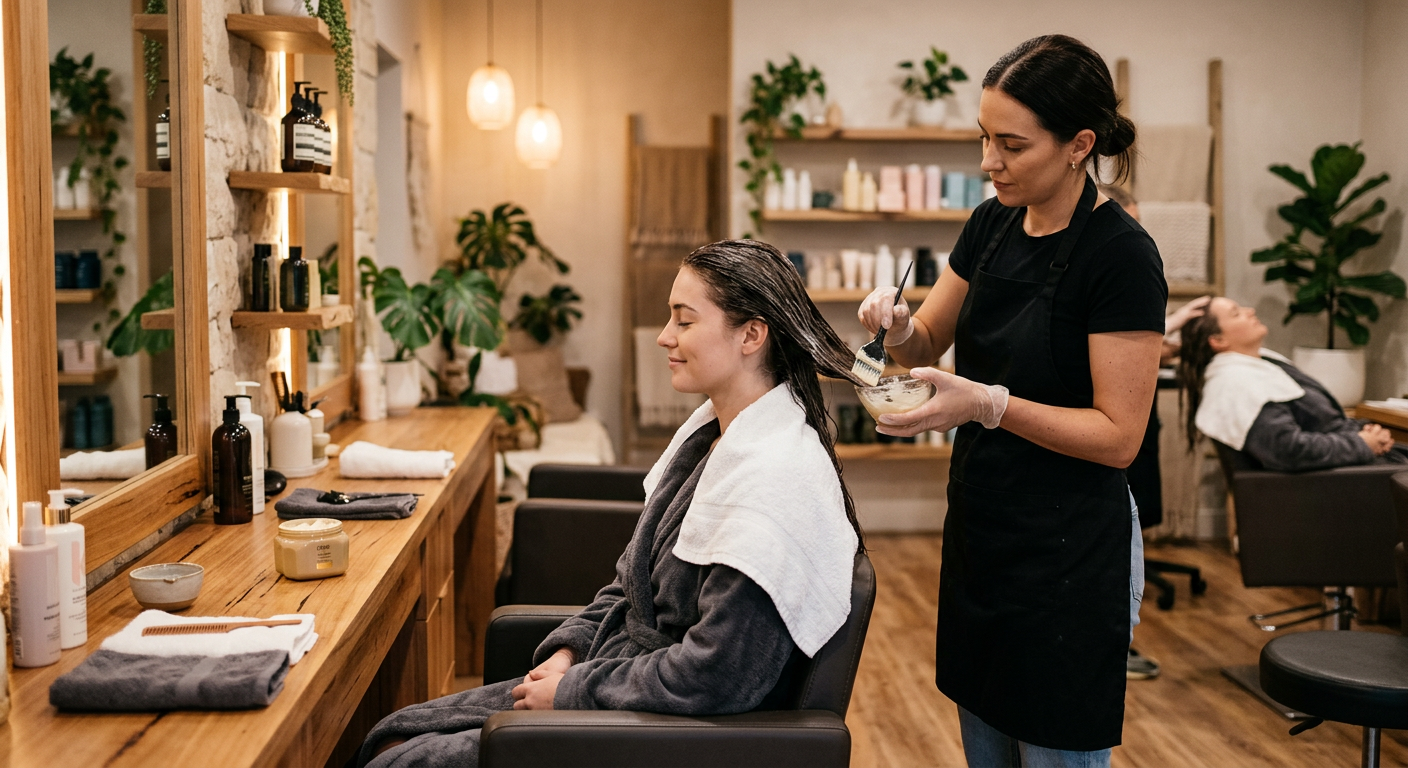
Coming in for a deep conditioning treatment in Ann Arbor is a different experience than anything you can do at home. Professional treatments use clinical-grade products and tools that penetrate the hair shaft at a deeper level. You leave with results you can actually feel — not just a temporary coating. Our stylists are licensed cosmetologists with years of experience treating Ann Arbor hair through every season.
Here is what happens from the moment you sit in the chair to the moment you walk out the door.
Step 1: Consultation and Hair Assessment
Before any product touches your hair, your stylist examines your strands carefully. They check for porosity, breakage points, and scalp condition. This matters because fine hair, color-treated hair, and natural hair each respond differently to conditioning agents. A stylist in Ann Arbor sees a wide range of hair types — from the dry, brittle strands that come with Michigan winters to the frizz that builds up in humid summer months near the Huron River corridor.
The consultation takes only a few minutes. But it shapes every product choice that follows. You are not getting a one-size-fits-all formula — you are getting a treatment matched to your specific hair needs.
Step 2: Shampoo Prep
Your stylist starts with a clarifying or gentle cleansing shampoo. This removes product buildup, hard water minerals, and excess oils. Clean hair absorbs the conditioning treatment far better than hair with residue sitting on the cuticle. Skipping this step — which is common with at-home treatments — reduces how well the product works.
In areas like Kerrytown or the Old West Side, many clients come in with significant mineral buildup from tap water. A proper shampoo prep addresses that before the real work begins.
Step 3: Application of the Conditioning Formula
Working in sections from root to tip, your stylist applies the deep conditioning formula through each layer of hair so no strand is missed. The formula used in a salon setting contains ingredients like hydrolyzed proteins, ceramides, and amino acids that rebuild the hair's internal structure — not just smooth the outside.
This is different from a store-bought mask that sits on the surface. Professional formulas bond to damaged areas inside the cortex — the inner layer of each hair strand. That is where real repair happens.
Step 4: Heat Activation
After application, your stylist uses a hooded dryer or a steamer to open the hair cuticle with gentle heat. This allows the conditioning agents to move deeper into the shaft. The heat phase typically lasts 15 to 30 minutes depending on your hair's condition and the formula being used.
Heat activation is one of the biggest differences between a salon treatment and a DIY mask at home. Without controlled heat, many conditioning molecules stay on the surface and rinse away. With it, the ingredients bond where they are needed most. Professional stylists follow established post-treatment care and safety procedures to ensure every step of the service is performed correctly and consistently.
Step 5: Rinse and Cold Water Seal
Your stylist rinses the treatment with cool water. The temperature drop closes the hair cuticle back down, sealing in the moisture and proteins that were just deposited. You will notice your hair feels smoother and heavier with hydration right at this stage.
A cold-water rinse is a small step that makes a measurable difference in how long the treatment lasts. Many clients who skip this at home wonder why their results fade within a day or two.
Step 6: Finish and Styling
After the rinse, your stylist may apply a leave-in product to extend the treatment's effects. Then they style your hair as usual. By the time you leave the salon, your strands should feel noticeably softer, more elastic, and easier to manage.
For clients in Ann Arbor dealing with seasonal dryness — especially heading into fall and winter — this final layer of protection makes a real difference in how your hair holds up between appointments.
Choosing the Right Deep Conditioning Treatment for Your Hair Type
Not every deep conditioning treatment works the same way for every head of hair. What works beautifully on fine, straight hair can weigh down thick coils or leave curly hair feeling greasy. Getting this match right is the difference between hair that thrives and hair that just survives. Ann Arbor salons see a wide range of hair types walk through the door — and each one needs a different approach.
Start by honestly looking at your hair's current condition. Dry and brittle? Limp and over-processed? Frizzy after every wash? Your hair is telling you something. The right treatment addresses the actual problem, not just the symptom.
Here is a simple breakdown by hair type:
- Fine or thin hair: You need moisture without weight. Look for lightweight, protein-rich treatments that strengthen the hair shaft without flattening volume. Avoid heavy butters or oils applied from root to tip.
- Thick or coarse hair: Your hair craves deep moisture and slip. Treatments with shea butter, avocado oil, or humectants like glycerin work well. You can handle a richer formula and longer processing time.
- Curly or coily hair (Type 3 and 4): Moisture retention is your biggest challenge. You benefit most from treatments that penetrate the hair cortex, not just coat the surface. Applying on soaking wet hair and using heat to open the cuticle makes a real difference.
- Color-treated or chemically processed hair: Chemical services strip the hair's natural lipid layer. You need treatments that rebuild bonds and restore elasticity. Protein-moisture balance matters here — too much protein on already brittle hair can cause breakage.
- Natural or unprocessed hair: Your hair is generally stronger but still needs regular moisture replenishment, especially during Michigan winters when indoor heat pulls moisture from everything, including your hair.
Beyond hair type, think about your hair's porosity — how well it absorbs and holds moisture. Low-porosity hair has tightly closed cuticles, so treatments sit on top rather than soaking in. Heat helps open those cuticles and lets the product do its job. High-porosity hair absorbs moisture fast but loses it just as quickly. Sealing with a light oil after treatment helps lock that moisture in.
Clients from the Kerrytown neighborhood often come in with hard water buildup from older home plumbing. Hard water leaves mineral deposits on the hair that block moisture absorption. In those cases, a clarifying step before the deep conditioning treatment makes the whole service work better. Skipping that step means you are conditioning a barrier, not your actual hair.
Frequency matters too. Fine hair may only need a deep conditioning treatment every two to three weeks. Thick, coily, or heavily processed hair can benefit from a weekly treatment. Pay attention to how your hair feels between sessions — if it feels dry or snaps easily within a few days, you may need to increase frequency or switch to a more intensive formula.
Something that comes up often in Ann Arbor is people using the wrong treatment for their current season. Summer humidity changes how your hair behaves. Winter heating systems dry hair out fast. The treatment that worked in July may not be enough in January. Adjusting your routine with the seasons is not overthinking it — it is just smart hair care. If you are unsure where your hair falls, we are happy to assess it before recommending anything — just give us a call.
Before recommending anything, your stylist takes a few minutes to look at your hair. They check for elasticity, porosity, and damage patterns. That assessment shapes everything that follows. You should never sit down for a treatment without that conversation first.
Your hair has been asking for this. Book your deep conditioning treatment in Ann Arbor today and walk out feeling the difference a professional service actually makes. Call us at (734) 757-6210 or schedule your appointment online. When you arrive, your stylist will assess your hair first — so everything that follows is built around what your strands actually need, not a guess.